I Learned to Notice Before I Learned to Ask
My mother found the drawing while cleaning the cupboard beneath the stairs.
She sent me a photograph of it on Sunday afternoon.
The paper had faded at the edges. A house stood beneath a yellow sun, its roof too large for its walls. Four people held hands in front of it. Above them, in uneven blue letters, I had written:
My Family
I remembered making it.
I also remembered never showing it to anyone.
My mother added a message.
You were always such an independent child. You never needed much from us.
She meant it kindly.
Still, I looked at the drawing for a long time.

I had been eight years old when I brought it home from school.
Our teacher had asked us to make something for Family Day. I spent the afternoon colouring the house, adding curtains, flowers, and a red dress for my mother.
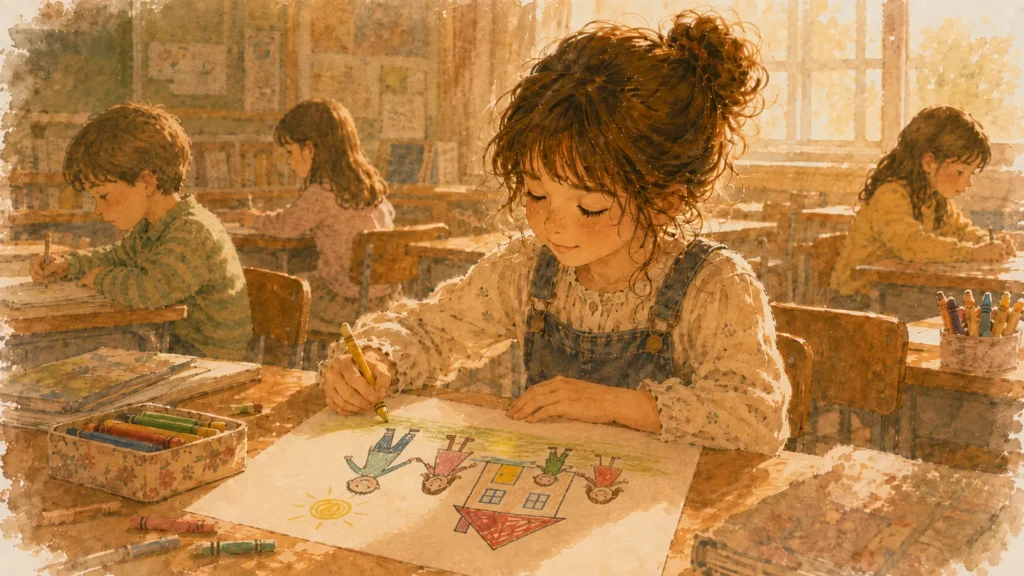
When the bell rang, I slipped the drawing between two books so it would not bend.
I planned to show it as soon as I got home.
But before I entered the kitchen, I heard a cupboard door close.
Not slam.
Just close more heavily than usual.
My father stood near the counter in his work clothes. My mother was at the sink, washing a plate that already looked clean.
“Did they tell you when?” she asked.
“No.”
“And you didn’t ask?”
“I said I don’t know.”
His voice was not loud.
That made me listen more carefully.
My father opened the refrigerator, stared inside, and closed it again.
Neither of them noticed me in the doorway.
No one was shouting. Nothing frightening was happening.
Still, the room felt smaller.
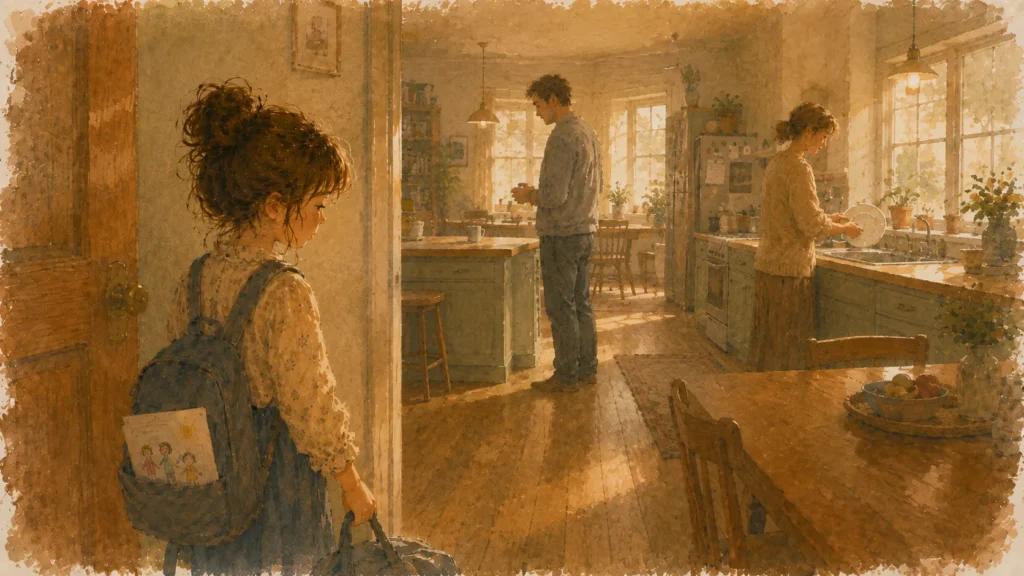
I lowered my school bag without letting the buckle click.
My younger brother ran in behind me, dragging a plastic truck across the tiles.
“Mum, look. The wheel came off.”
“Not now,” she said.
“But it won’t move.”
“I said not now.”
Her voice sharpened.
Before he could cry, I took the truck.
“I can fix it,” I whispered.
He followed me into the living room.
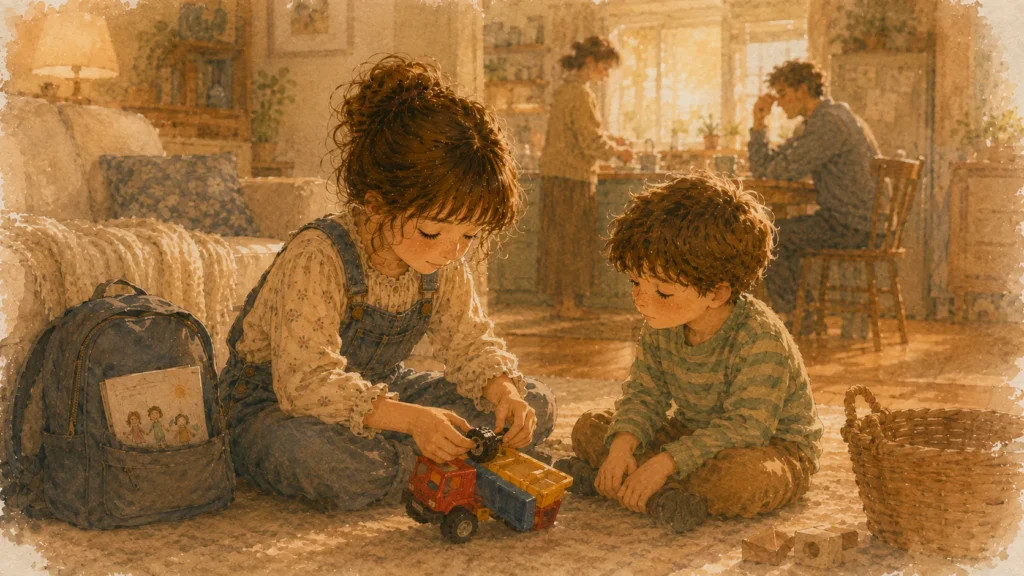
I pushed the wheel back onto the axle.
“It works,” he said.
“Keep it quiet.”
He nodded.
The drawing was still inside my bag.
So was a note asking parents to bring food for Family Day. That morning, I had imagined asking my mother to make the apple cakes she sometimes baked.
Now the request felt too large.
I pictured her coming home from work and having to find apples, butter, and time.
Perhaps I could bring nothing.
Perhaps no one would notice.
At dinner, my parents spoke about ordinary things. Their voices had softened, but I continued to study them.
I waited for the right moment to mention Family Day.
It did not come.
When my brother nearly knocked over his glass, I caught it before it fell.
“Careful,” I told him.
My mother looked at me.
“Thank you.”
After dinner, I cleared the plates before anyone asked.
“You don’t have to do all that,” my father said.
“It’s okay.”
My mother touched my shoulder as she passed.
“You’re the one I never have to worry about.”
I smiled.
The words felt warm.
They also felt like an instruction.
That night, I took the drawing from my bag.
One corner had bent. I placed it on my desk and smoothed it with both hands.
For a moment, I considered carrying it downstairs.
My parents were in the living room. The television was on, but neither of them seemed to be watching.
I imagined my mother smiling at the flowers. I imagined my father saying I had drawn him too thin.
I wanted that.
But wanting it felt like adding something to a room that was already carrying enough.
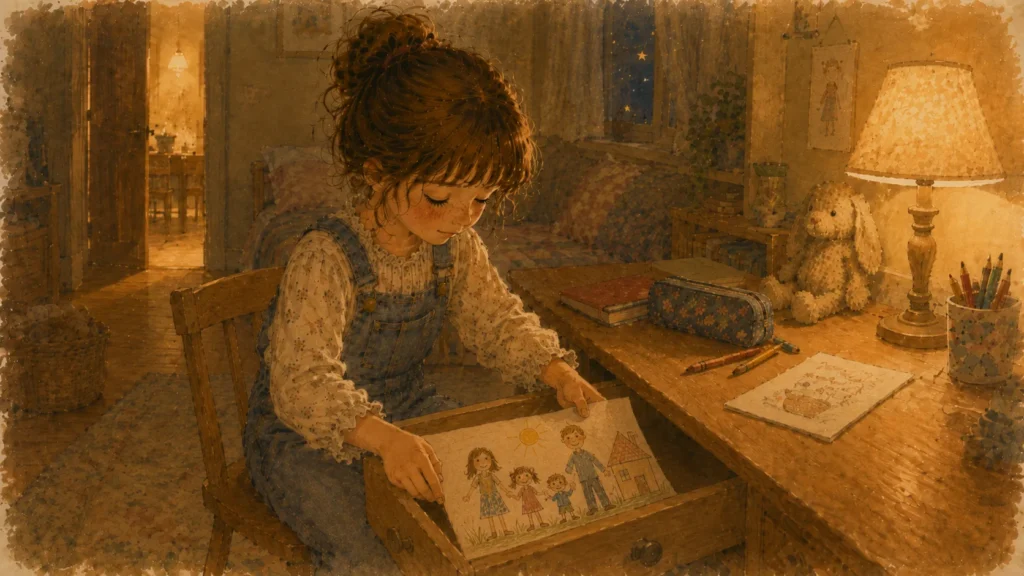
So I put the drawing inside my desk drawer.
The school note went beneath it.
The next day, I told my teacher my family would not be bringing food.
“That’s perfectly fine,” she said.
Still, I spent the morning trying to be especially helpful. I collected the pencils, let another child go ahead of me in line, and volunteered to wash the paintbrushes.
No one had asked me to make up for anything.
I did it anyway.
Years later, my mother would remember me as easy.
Independent.
Thoughtful.
She was not wrong.
I had learned to notice when people were tired. I knew when a question should wait and when a room needed less noise.
Those abilities helped me. They kept some evenings calm. They helped me stay close to the people I depended on.
At eight years old, becoming quieter was not a foolish choice.
It was one of the few choices available to me.
The problem was not that I learned to do it.
The problem was that I kept doing it long after I was no longer a child standing in a kitchen doorway.
Years later, the same reflex still arrived before I could question it: notice the change, reduce myself, and try not to add more weight.
As an adult, I still waited for the right expression on someone’s face before asking for what I needed.
I still treated other people’s tiredness as a reason to postpone myself.
I still believed that being easy to love meant arriving with as little weight as possible.
The old rule had once helped me feel safe:
Notice first.
Adjust quickly.
Ask for less.
But what protected me then often exhausted me now.
I looked again at the photograph.
The four figures stood beneath the yellow sun, holding hands in front of a house with a roof too large for its walls.
I typed a reply.
I remember this one. I was very proud of it.
A few seconds later, my mother answered.
You should have shown us. We would have loved it.
I believed her.
Perhaps the room had been heavy that evening, but not too heavy for my drawing.
I had simply been too young to know that people could be worried and still have space for me.
I had learned to read the room before I learned to ask what was actually happening.
I had learned to reduce my needs before anyone told me they were too much.
And because people praised the quiet that followed, I mistook disappearing for kindness.
After that, I began noticing the brief moment between sensing a change and making myself smaller.
I did not always know what to do with that moment.
But sometimes, I managed not to disappear immediately.